
Patient Specific Implant (PSI) have revolutionised the treatment of secondary orbital reconstructions. The above picture red broken line shows level of the eye balls before and after secondary reconstruction of left orbit with a PSI.

This young man suffered from a Road traffic accident about a year back before he come to see us. He had a left orbital floor fracture with bilateral inferior orbital rim fracture at the time of injury. He refused surgery at the time. Below you can see the old and new 3D reconstruction CT scans dated more than a year apart.
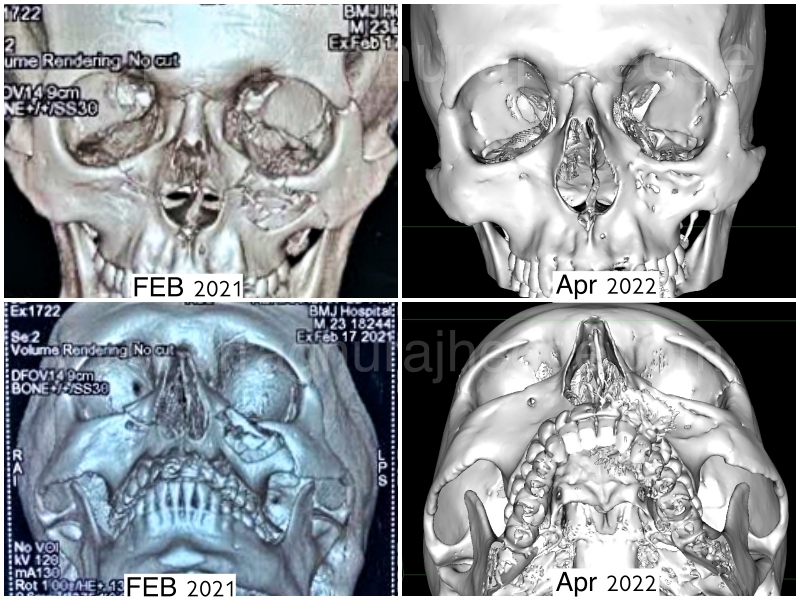
However, slowly he started developing Left eye enophthalmos (eye sinking into eye socket), left orbital deformity compared to right eye. In addition, he had restriction in movement for upgaze and diplopia (double vision) in certain gazes. He was advised a PSI for correction of this late deformity.
Virtual planning:
🖥️⌨️💻👩💻🧑💻💽🖱️
A PSI is designed using the normal side mirrored to the other side as a template. The customisation and design modifications is done by collaboration of the operating surgeon 👨⚕️with the bio-medical design engineers 👩💻via video-conferencing calls.
The resulting design is used for 3D printing the implant mock up and the final implant on approval of the mock implant. Below you can see the mock up as well as 3 D printed orbital implants 👀 on the 3D printed anatomical skull model 💀 of the patient made of plastic.

His post operative CT scan shows perfect correction of his Floor fracture and zygoma augmentation.
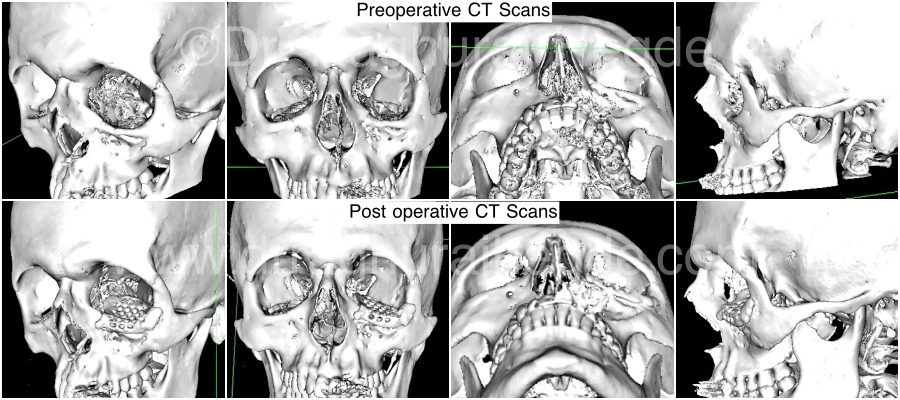

In addition to correcting the facial deformity, both enophthalmos and diplopia on upgaze was completely resolved. Needless to say, the patient was thrilled.
Implants can be made up of Titanium (commonly), Polycaprolactone (Bioresorbable/Osteo-integrative implant) or the newest kid on the block Poly Ether Ether Ketone (PEEK). PEEK is a semi-crystalline linear polycyclic thermoplastic that has been proposed as a substitute for metals in orbital implants.
PSI is an excellent modality to provide precise, predictable and reproducible results resulting in both aesthetic and functionally good outcomes.
📆Virtual Planning and PSI 3D printing time: 2 weeks
⏲Surgery time: 2 hours
💉Anaesthesia: Done under general anaesthesia
🗓️Downtime post surgery: 3-4 weeks
📈Duration of effect: Long term
📠 Phone: +91 80 2502 3257
📩 E-mail: raghuraj@drraghurajhegde.com
🖥️ Website: www.drraghurajhegde.com
©All patient photos are being used with the express consent of the patient. These cannot be shared or reproduced elsewhere
 DR. RAGHURAJ HEGDE